Invisible Home Dangers: The Risk of Electrical Fire from Arc Faults
Tuesday January 30, 2018

It's one of those electrical terms that just sounds like it is a sign of warning: an arc fault. And in this case, it does.
Understanding Arc Faults
To say that arc faults are a dangerous electrical problem is an understatement, more than half of the nearly 51,000 electrical fires that occur in the United States each year are traced to arc faults. And the damage is devastating.
An arc fault occurs when electrical wiring, appliances or electrical devices become overheated, damaged or otherwise stressed. Most often, arc faults occur when old electrical wires become cracked or frayed, when outlets or circuits become overloaded or when a screw or nail pierces a wire through a wall.
What is an AFCI?
True to their name, they literally “interrupt” an arc fault; they prevent an overheated, overloaded or short-circuited breaker from wreaking havoc in your home. Located in your home's electrical panel, an AFCI functions as a “normal” breaker while providing a higher level of protection. And like a normal breaker, an AFCI will “trip “ – or shut down the electricity – when it senses a hazardous condition. AFCIs often can be distinguished from a normal breaker by a different-colored button near the handle.
Prevention is a Key Part of Electrical Safety
The National Electrical Code – the electrician's “Bible” that establishes electrical standards – has required AFCIs for bedroom wiring since 2002. The use of AFCIs was expanded in 2008 to include the wiring of other rooms in a home, including the living room, dining room, family room, hallways and closets.
The U.S. Consumer Product Safety Commission says that AFCIs could prevent more than 50 percent of the electrical fires that occur every year in American homes. And this statistic points out the obvious: just because the electrical code requires AFCIs doesn't necessarily mean that your home is equipped with them-so if you're uncertain, call us to inspect your home's electrical panel.
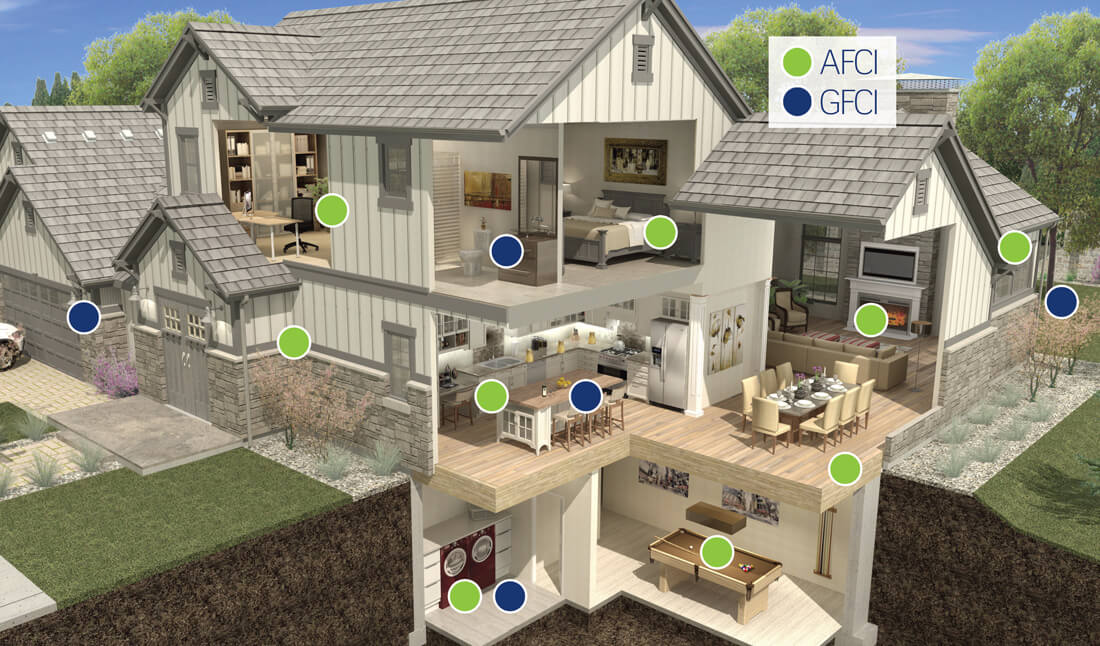
The Difference Between AFCIs and GFCIs
GFCIs became common in the 1960s to protect people from electrical shocks if a tool or appliance becomes energized because of a ground fault. This risk was (and is) especially prevalent in kitchens, bathrooms and laundry rooms. Again, an AFCI protects branch circuit wiring from igniting into electrical fires.
It's important to combine the protection afforded by AFCIs (which protect the wiring) and GFCIs (which protect people). The obvious way to accomplish this is to use an AFCI circuit breaker along with a GFCI outlet (otherwise known as a receptacle). In this way, you can ensure that your home is as safe as it can possibly be.
If you'd like to make sure your home is up to par when it comes to electrical safety, contact Chapple Electric today.
About Chapple Electric
Chapple Electric LLC is a second generation, family owned company that was started in 1978 by our founder, Charles Chapple. What started out as a small 2 man operation doing residential electrical repairs has now become a large commercial, residential and industrial electrical contracting company, which operates with several crews across the state of Michigan. From the very beginning, complete customer satisfaction has been the cornerstone of our success and longevity.Chapple Electric is one of Michigan's most trusted names in electrical repairs, installation and upgrades. Since 1978, we have been committed to excellence in design, workmanship, competitive pricing and customer service.
Read More
Why Choose Chapple Electric?
At Chapple Electric, we know that the electrical system is the lifeblood of any structure. How that system functions can either enhance or hamper the comfort and productivity of its occupants. In order for the electrical system to function properly, it must be designed and tailored to the owner's needs and usage, correctly installed and be backed by a service team available 24 hours a day 7 days a week.To ensure this happens, you need to work with a company that's on top of the trade. One that knows electrical systems inside and out, and is in step with all the current codes and standards for the profession as well as the latest in technological and product advances. A company that has the professional staff and experience to design, build, deliver, install and maintain a system that's done right. Read More
Our Location
Corporate
- 11220 Torrey Road
- Fenton, MI 48430
- Phone: 810-691-6921